Origin: Old
ບຸນໄຫຼເຮືອໄຟ Happy Boun Lai Heua Fai
Not Loy Krathong.
The Night the Khong Catches Fire
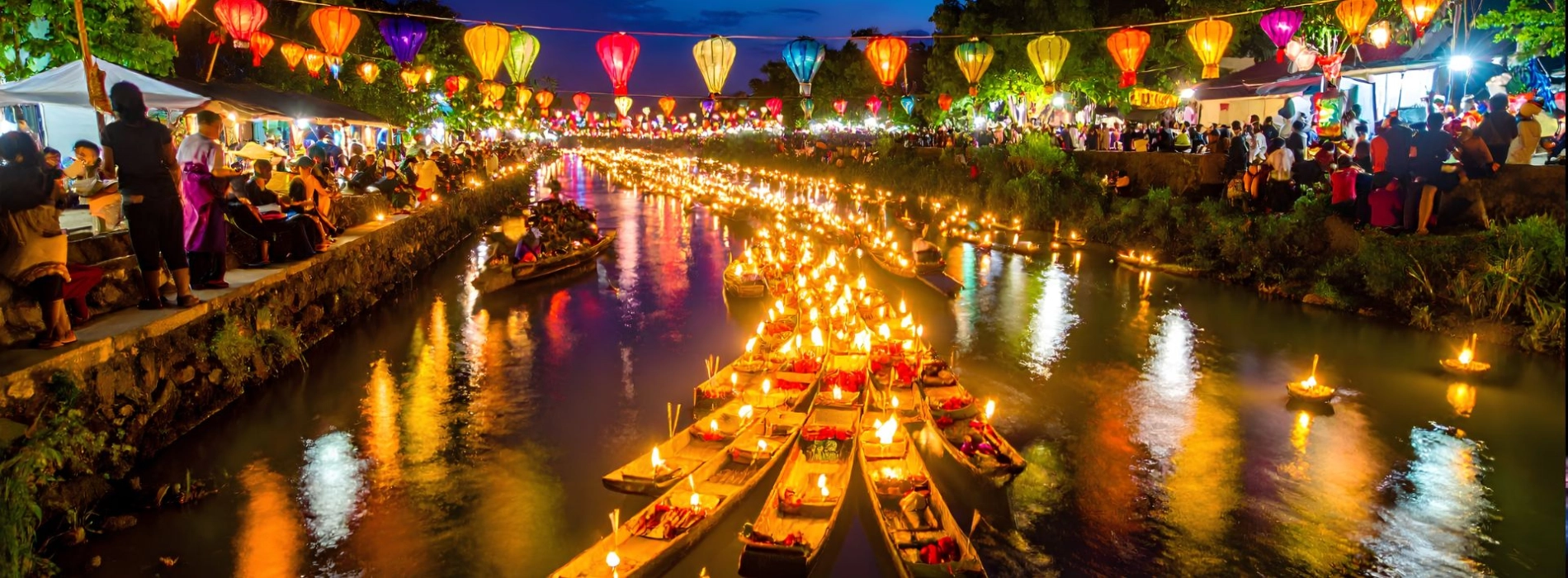
On the full moon that ends the rains retreat, the river does something strange. It starts to glow.
Boats drift out onto the water, some as small as your hand and some longer than a house, all built of banana trunk and bamboo and lit end to end with flame. They turn slowly in the current and float downstream, burning. From the bank it looks like the river is carrying fire somewhere it needs to go.
The Lao name for this night is
ໄຫຼເຮືອໄຟ lai heua fai “letting the fire boats flow”
Lai is to let something drift with the current. Heua is a boat. Fai is fire. Not a basket, not a lantern: a boat of fire. And it doesn't fall on just any full moon. It falls on Ok Phansa, the full moon of the eleventh lunar month, the night the monks come out of three months of retreat. If you want the full story of the rains retreat and the night it ends, I wrote about it in Coming Back Down on Life is Buddhafull. The fire boats belong to the end of the rains.
Ask ten people why we float them and you may get ten answers. What I found in my research is how many of those answers lead back to the same place.
A light to welcome him home
The most common answer is the simplest. During one rains retreat, the story goes, the Buddha went up to a heaven realm to teach his mother, who had died a week after he was born. When the three months ended, he came back down to earth on a staircase of gold, silver, and jewels, and the people lit the night to welcome him. Every Ok Phansa, the lights go out again. It's a homecoming.
A footprint on the riverbank
Another answer comes from the story of Puṇṇa, a merchant from a hard country called Sunāparanta. He heard the Buddha teach, gave his fortune to his brother, and became a monk.
When Puṇṇa said he wanted to go back home to practice, the Buddha warned him that its people were known for their cruelty. What if they insult you? It's better than being hit, Puṇṇa said. What if they hit you? Better than being stabbed. What if they kill you? Then, Puṇṇa said, I'll have been freed from this body without having to ask anyone. The Buddha let him go.
Puṇṇa won over that hard country, and its people built a hall of sandalwood and invited the Buddha to come.
The journey is something to picture. The Buddha set out from Jetavana monastery with 499 arahants, fully awakened monks, five hundred in all. The king of the gods had the heavenly architect Vissakamma build them peaked pavilions that floated through the sky. One pavilion was left empty. On the way they passed a mountain where a hermit named Saccabandha lived. The Buddha came down and taught him, the hermit became an arahant on the spot, and he took the empty seat.
On the way home, they came to the Nammadā River. The Naga king who lived there invited the Buddha down into the Naga realm, and there the Nagas took refuge in the Buddha, the Dhamma, and the Sangha, and took up the precepts. When the Buddha was about to leave, the Naga king asked for something to bow to. So the Buddha pressed his footprint into the stone of the riverbank as a shrine for them. He left another on Saccabandha's mountain.
We can't travel to the Naga realm to bow at that footprint. But every river runs into every other. So, as my research tells it, we send our light down the water to reach it. Along the Khong, this is one of the most common reasons given for the fire boats.
The guardians below
Then there are the Naga, the great serpent beings of the river. This part of the story is older than Buddhism here, and it's worth saying so honestly. Long before the monks came, people along the Khong respected the spirits of the water, and that respect never left.
But it found a home inside the faith. In the old texts, a Naga king coiled around the Buddha to shelter him from a storm. In Luang Prabang, the Naga said to live beneath Mount Phousi is also said to guard the Buddha's footprint on its slope. When we float our lights for the Naga, we're thanking the guardians of the river, and in this telling, the guardians of the river are guardians of the Dhamma too.
The monks who walked on air
This next telling is one of my favorite finds from my research. It's a legend, and I'll pass it on as one.
About 236 years after the Buddha passed away, two monks named Sona and Uttara were sent out to carry the teachings to a far country the Indians called Suvannabhumi, the Land of Gold. The telling says that land had two halves. The western half, around the Chao Phraya River, already had Brahmin religion well rooted, with its rituals and amulets. The eastern half was the basin of a great river.
The Buddha, the story says, had already marked that river. Before he died, he told his disciple Mahakassapa to carry his breastbone to a hill beside it, Phu Kamphra, where That Phanom stands today. The Buddha called the river the Kurunthi, and said the people born along it would be gentle, humble, and easy to teach, and that the Dhamma would last there for five thousand years. And the Lao never stopped calling it by its own name: not Mekong, but Nam Khong.
But when the monks arrived, the river was not at peace. Water spirits lived in the Khong, and they came up at night to prey on children, the king's children above all. The king had posted soldiers along the riverbank to kill anything that came out of the water.
So when five strange figures came down out of the sky, shaved heads and patched yellow cloth, the soldiers took them for a new kind of ghost and attacked. Arrows missed. Blades found nothing. The monks simply rose into the air, some lying down, some sitting, some standing, some walking across the empty sky, smiling.
Then one monk, the one gifted with languages, came down to speak. We are not ghosts, he said. We harm no one. We don't kill, steal, lie, or take what isn't given. If water spirits are troubling your city, lay down your weapons and rest. We will take care of it.
That night the water spirits came, and they found monks everywhere they turned, multiplied into thousands, surrounding the riverbank. The spirits breathed smoke and fire. The monks blazed back with a radiance brighter than any flame, until the spirits, scorched, fled down into the river and never rose again.
In the morning the people came out of every house in every village. The monks taught them the Brahmajāla Sutta. The telling says sixty thousand people tasted the Dhamma in that first sitting, and that princes and princesses from every city asked to be ordained. There's an old Pali verse the monks still chant for blessings that remembers it: Suvaṇṇabhūmiṃ gantvāna Soṇuttarā, “Sona and Uttara went to the Land of Gold.”
In my research, this is one of the roots of the boats of light. We set fire on the water in honor of those first monks, who appeared in the sky above the river and brought the Dhamma to the Khong.
A month later, a different festival
One full moon after Lai Heua Fai comes Loy Krathong. From the bank, a krathong and a fire boat can look like cousins. Underneath, they come from different places.
The first clue is the calendar. On both banks of the Khong, in Laos and in Isan, the Lao-speaking northeast of Thailand, the old year runs on
ຮີດສິບສອງ ຄອງສິບສີ່ heet sip song, khong sip si “the twelve customs and the fourteen ways”
That's a merit festival for every month of the year, drawn from the Buddha's teaching. Go through all twelve and Loy Krathong isn't among them. From what I found, it reached the Isan countryside only recently, along with the paved roads, the electricity, and the television. In Laos it never became a festival of its own. What crossed over was mostly its name.
As for where Loy Krathong does come from, my research traces it to an old Brahmin practice called thipawari, from Sanskrit words for “lamp” and “water.” Lamps were floated on the river at the turn of the rains to honor Narayana, the god Vishnu, who is pictured sleeping on the cosmic ocean. You may know that image from the famous carved lintel at Phanom Rung. India still floats lamps on its rivers in that same season. King Rama IV, writing in 1863, also described Loy Krathong as a Brahmin festival that Thai Buddhists had adopted. Its best-known origin story, the court lady Nang Noppamas, comes from a novel written around 1850.
You'll sometimes hear the Nammadā footprint given as the reason for Loy Krathong too, even from monks I respect. From my research, that story belongs to the fire boats of the Khong. It was attached to the krathong later, laid over the older lamp offering.
There's one more clue, and it's a good one. Loy Krathong's famous song pictures the twelfth-month moon over rivers brimming to their banks. That's true of the central plains, where the rivers run close to the sea. But by the twelfth month, across Laos and Isan, the smaller rivers and streams are already shrinking back into pools. There's a line I came across that says it perfectly: floating a krathong on a dry Isan creek makes about as much sense as dipping a ripe banana in padaek.
None of this makes Loy Krathong less beautiful. It's a real tradition, with its own history, and it belongs to the people who carried it. It just isn't ours.
Why the name matters
Yes, Lao people float small offerings on Ok Phansa too, and many of us call them krathongs. But on that night, they're part of something bigger. Each small light set on the water is a little fire boat, and the night is still Lai Heua Fai.
Think of it this way. Kwanzaa and Hanukkah both come in December, and both involve lighting candles night after night. A Kwanzaa family could say “we celebrate Hanukkah” because more people would know what they meant. But they'd be giving away their own story to borrow someone else's.
That's what happens when Lai Heua Fai gets called Loy Krathong. Nobody means harm. It's a bigger name, an easier name, a name the whole region learned from the radio. And it's easy for temples and community groups, especially out here in the diaspora, to put “Loy Krathong” on the flyer because that's what brings people in. I understand that. In my research I came across monks who were much sharper about it than I'd ever be. They watched temples sell krathongs by the hundreds and hire movies for the crowd, and they asked where the Dhamma had gone. I'd ask something gentler: let's keep the crowd and give it back its own name. When the name goes, the stories go next. And these stories are too good to lose.
Keeping the lamp lit
There's an old comparison I came across in my research: the Dhamma is like an oil lamp. It burns for a long time, then the oil runs low and the flame dims, and you think it might go out. Then someone comes along and fills it again, and it burns bright.
Every Ok Phansa, someone along the river builds a boat, lights it, and lets it go. That's the lamp being filled.
So this year, when you set your light on the water, say its name. Lai Heua Fai. And if there's a kid standing next to you, tell them about the monks who walked on air.