Origin: Old — with a later form abroad
ບຸນຊ່ວງເຮືອ Boun Suang Heua
Boat racing does not sit in one month. In Luang Prabang the races fall in the ninth, alongside Boun Khao Padap Din. In Vientiane they fall in the eleventh, at Boun Awk Phansa. In the United States they fall in summer. What follows is Luang Prabang custom, which is the most fully documented and the most elaborate — other places do it differently, and where those differences are known they are noted.
For most of the year the boat is not really a boat. It is a long shape under a roof on temple ground, and the village walks past it on the way to do other things.
Then the rains come, the rice goes in, and someone decides it is time. They pull it out into the light and spend a week on it — patching, repainting, waxing the hull so the water lets go of it faster. It is twenty metres of hollowed tree, a metre and a bit across, barely half a metre deep. Forty or fifty people will sit in it in pairs. Before it goes anywhere near the river, offerings are made to the spirits of the boat at the village temple, and on the morning of the races the monks come out and bless the boat as well as the crew.
The boat gets a ceremony of its own. Everything else about this festival follows from why.
It begins with a tree. Racing boats in Luang Prabang are cut from a single trunk, and in Lao belief a tree is not empty — it holds a spirit, a phi or Nang Mai, and she is female. So before the tree can be felled, rites are performed for the woman living in it. She is not evicted by the axe. She stays with the wood, travels into the finished hull, and lives there afterward, which is why the boat is then given her name. The principal boat at Vat Xieng Thong is called Nang Bua Ngern, Lady Silver Lotus. A woman lives in a tree, the tree is asked, the tree becomes a boat, the boat keeps her, and the boat spends the rest of its life in a shed on the grounds of a Buddhist temple, blessed by monks once a year.
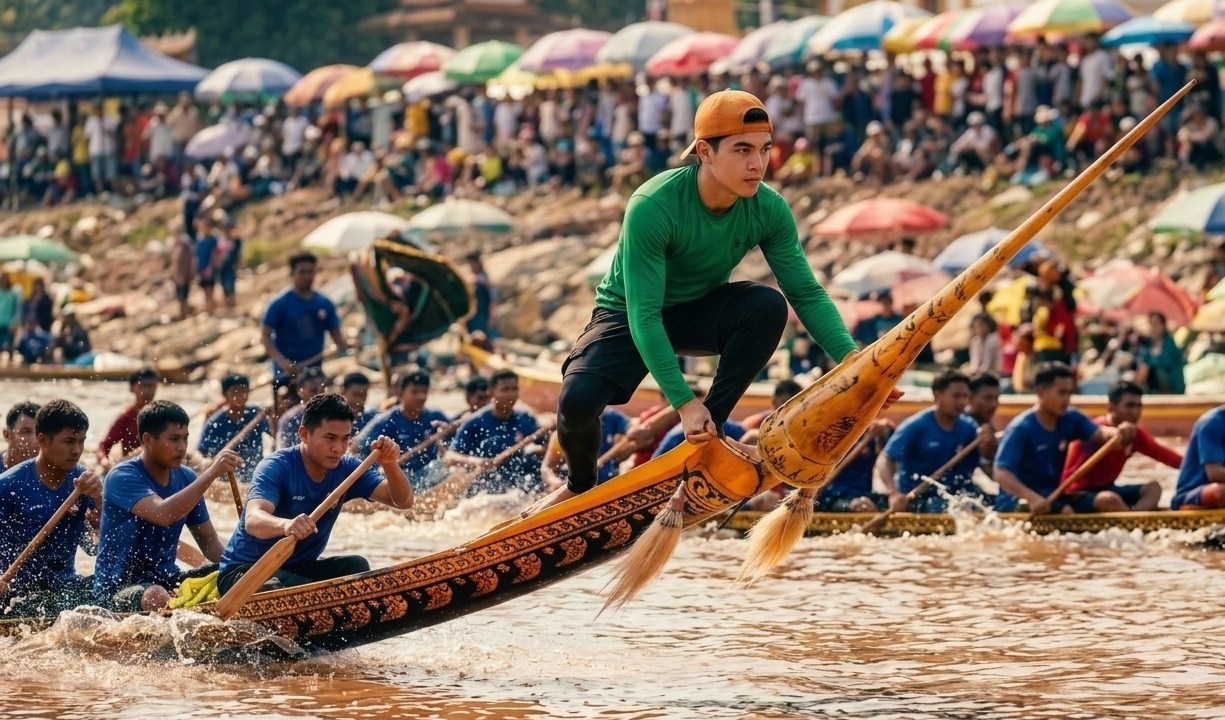
The shape of her is specific, and regulated. In Luang Prabang there are strict rules keeping the boats to local form, and every hull must be submitted for inspection before race day — nobody turns up with a faster design. The bow and the stern are called ngeum, and both rise into horn shapes. On the bow sits a gold-coloured horn called a mak beng.
A mak beng is not a boat fitting. It is a ritual object, and most Lao people have knelt in front of one.
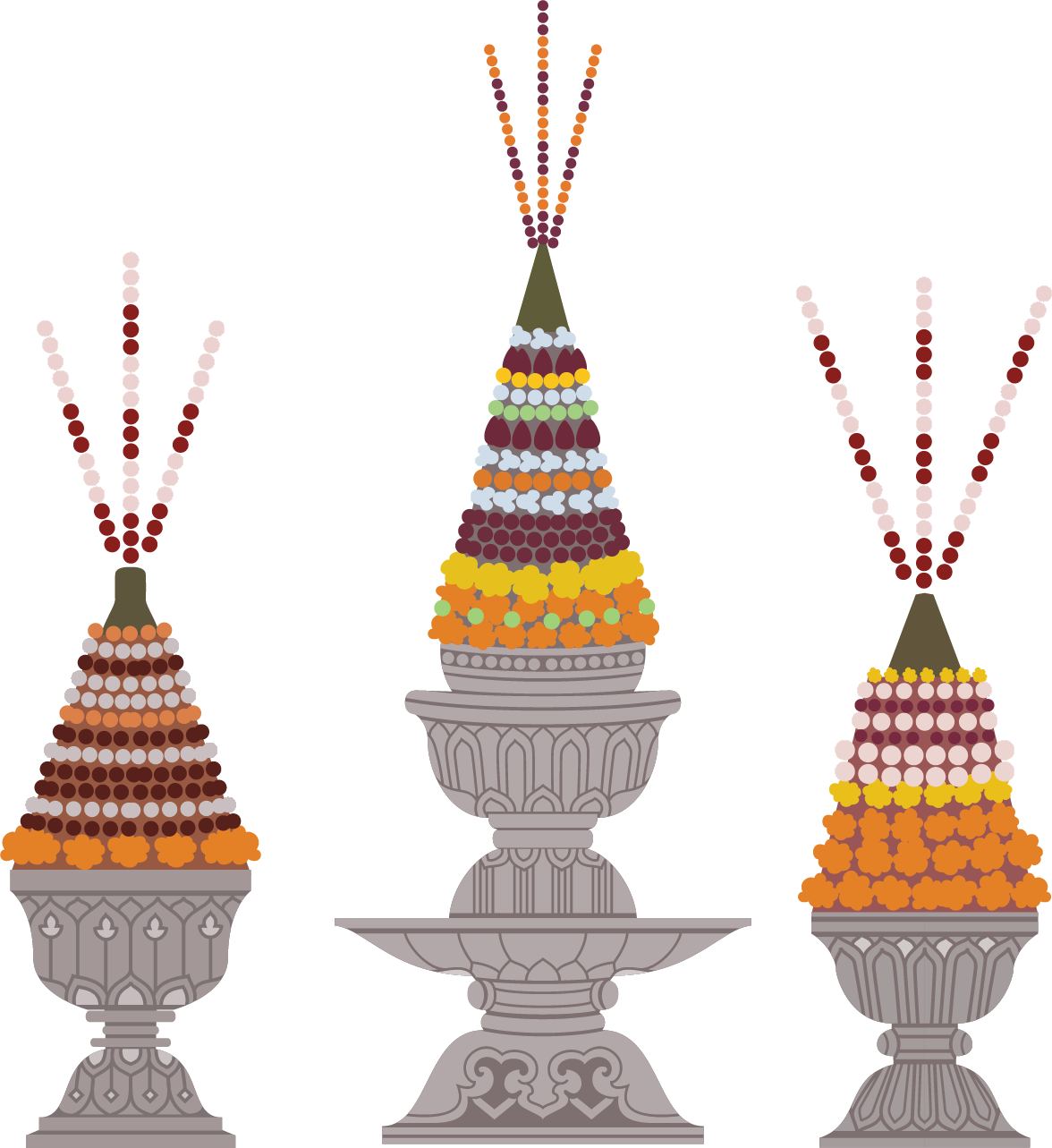
In a baci, the centrepiece is the pha khuan, the tray of souls, and rising from it is a cone of folded banana leaf stuck with marigolds and dawk phut, built by hand, usually by older women, over hours. That cone is the mak beng. It is what the wandering khwan are called back to and gather around, and the ceremony begins when the mor phon lights the candle at its tip. Smaller single cones are made for other occasions — one about thirty centimetres tall, carried to a temple and handed to the monks at a memorial for someone's son.
So the mak beng is the thing a soul comes home to.
And one is fixed, gilded, to the front of a boat that has a spirit living in it, receives offerings before it goes in the water, and is blessed by monks on the morning of the race. The reasoning behind that pairing has not survived alongside the practice. What is certain is what the object is: whatever else that boat may be, it goes onto the river with a soul-vessel mounted at the front, facing forward, entering the water first.
Inside, forty to fifty rowers sit in pairs facing forward — the nak siphai — working short oars that are not fixed to the hull. Three or four stand at the back to steer. And one man crouches right down at the bow beneath that gilded cone, driving the boat on with a rocking forward motion called nyom, which is not paddling at all; it is closer to willing the thing along with his body. The number of crew is not regulated. By tradition all of them are men.
She is going out onto water that belongs to something else.
The naga hold the river, and not in a decorative way. They govern rain and the fertility of the ground. There is a belief around Vientiane that they carry the rice grains down into the water and then give them back — anyone who has farmed a floodplain will recognise the description. It is the flood cycle, told as a relationship with someone. In Luang Prabang the naga are not abstract at all. They have names and they have addresses. Chai Chamnong lives at the rock at the mouth of the Houai Hop, below Vat Tai Phuttabat, guarding the southern approach to the city. Ai Thong Kwang lives at the rock called Kon Kai Fah where the Nam Khan meets the Mekong. And two queens, Nang Dam the Black and Nang Done the White, live in whirlpools north and south of Ban Xieng Mene.
The racing was never originally about racing. It was an offering, and its stated purpose was to keep peace in the kingdom by paying the beings who guard it.
And it was not one event but a sequence, spread across days. The ninth-month races opened on the eighth day of the waning moon at Ban Had Hien, with racing around the mouth of the Houai Kang. On the twelfth day they moved to Ban Sanghalok, between the Houai Hop and the Dong river, and on that day the king travelled south on the royal boat to present his offering to Chai Chamnong at his rock — banana and areca nut, in a small square container folded from banana leaf. The races followed, between the local villages, under the king's eye.
But the largest races were on the Nam Khan on the fourteenth day of the waning moon. The king led a flotilla down from the Royal Palace — the Heua Phathinang, the Golden Boat, thirty metres and sixty-nine oarsmen, with a black boat crewed in red to his right and a green-crewed boat to his left — out to the rock at the river mouth to make the same offering to Ai Thong Kwang. Then he would go up the Nam Khan to the pavilion at Phamxai, behind Vat Pak Khan, and watch from there.
The town rowed past him in an order set in the early 1800s by King Mantharath: Vat Xieng Thong against Vat Nong to begin, then outward from the centre of the city, ending with Ban Pak Meuad against Vat Sanghalok — the northern and southern limits of Luang Prabang, facing each other last. It was a map of the city, raced.
And it was not a competition in the way we mean the word. A boat could lose a round and keep racing later in the day, under a system elaborate enough that the point was clearly not elimination. Turning up and being in it mattered more than producing a winner. The prizes were small. Their value was that the king had handed them over.
Before any of that, though, there was one more race, and it is the strangest and best-preserved thing in the whole festival.
Two boats would come across the water from Ban Xieng Mene, one crew dressed entirely in white and the other entirely in black. They raced each other once, in front of everyone, and the white boat won. Not usually. Always. The result was arranged in advance, every year, because the two boats stood for the two naga queens, and the harmony of the kingdom was understood to depend on the outcome coming out that way. It was not a contest. It was a statement in the shape of a contest — white over black, performed on the river, so that the order of things was visibly restored before anybody competed for anything real.
Why it must be white is no longer known. The rule survived intact and the reasoning behind it did not.
And it is still running. Every year in Luang Prabang, while the village crews are boarding at landing points around town, two boats come quietly across from Ban Xieng Mene, first to the rock to make their offerings and first onto the water an hour later. White still wins. Except at bow and stern, the rowers in both boats are older women.
Riding at the front of the village boats through all of this are the Nang Heua, the boat maidens — young women whose role is to please the naga and bring their team luck, seated toward the bow through the blessing and the procession and stepping out before the racing starts. How old that role is remains unsettled; some hold it to be a recent addition.
But look at who is female in this. The spirit in the hull is a woman. The boat carries her name. The beings addressed before the races are queens, and the boats that honour them are rowed by grandmothers. A young woman seated at the bow to please a naga sits inside that pattern rather than outside it, whether she has been there for centuries or for decades.
Buddhism arrived into all of this and did not clear the ground first, which is how it worked everywhere in Laos. It had no quarrel with the naga in any case — they were already in the scriptures, where a naga king spread his hood over the Buddha through seven days of storm. They came with the teaching rather than against it and settled in beside the ones already living in the river. What Buddhism brought was a calendar and a frame. The races were fixed into the Buddhist year, inside the rains retreat, peaking at its end and running on toward Kathin. The long boats picked up a second job carrying Buddha images in water processions. The shed they sleep in became temple property. Monks began blessing the crews. Merit entered the picture, and a race became somewhere merit could be made. The offerings at the rock carried on exactly as before.
Around the racing, the rest of the festival assembled itself. In the countryside every household in the host village cooks for guests, and almost all of them make khao poon. At the temple the night before — sometimes two nights before — an open-air bar and a dance floor go up, a band plays, and the crews and everyone from the surrounding villages drink and dance into the morning. At the end of the retreat come the fire boats: rafts of bamboo and banana stem loaded with candles and flowers and incense, blessed at the temple, carried down and set adrift after dark in their hundreds, which is thanks to the mother of the river and a way of letting the year's bad luck float off downstream.
Go this year and the whole history stacks up in a single morning. Around half past seven the teams gather at their village temples and the monks bless the boats and the crews. Then the Nang Heua and the rowers walk the boat three times around the ordination hall before carrying it down to the water. By nine every village boat in Luang Prabang has converged on the rock at the mouth of the Nam Khan to leave its offering for Ai Thong Kwang — the same rock, the same offering, minus the king, who has been gone for fifty years. Then the white boat beats the black boat. Then government dignitaries make speeches from the Phamxai pavilion, which is the pavilion the king used to watch from. Then, around ten, the racing starts. Boats line up in pairs at a pontoon set mid-river and run eight hundred metres down to the finish at Phamxai, twenty-five boats and forty or fifty races, the last of them often around six in the evening. The river road is closed all day and packed with stalls, and a great many people who come for it will only ever catch a glimpse of an actual boat.
By any visible measure the festival is in better health than it has been in a century. Bigger crowds, corporate sponsorship, live national television, dignitaries down from Vientiane.
And inside that, things have quietly gone.
Luang Prabang used to race twice a year, in the ninth lunar month and again in the twelfth. The twelfth-month races stopped in 1930 and have never come back. An entire half of the cycle — its own days, its own rituals, its own offerings — simply ended, and nobody standing on the riverbank today would have reason to suspect it was ever there, because the remaining half looks whole.
The old structure of the contest has become heats and pairs and elimination, with the running order fixed by a committee weeks in advance rather than by a king two centuries dead. The prizes are now worth having on their own terms, which means the thing you win is the object rather than the hand it came from. Village crews share the river with corporate teams, and the 2024 races were won by a bank.
And the royal boats are still here. The Golden Boat, built in 1964. The black boat, built in 1963, sixty oarsmen, which travelled at the king's right hand. The green one, built in 1964, fifty-three oarsmen, which travelled at his left. All three sit neglected under a shed on the grounds of the former Royal Palace. Three boats that once carried a king out to hand a parcel of banana leaf to a serpent, in the dark, a short walk from a festival the entire country is watching on television.
Nothing visible was removed. The boat, the river, the crowd, the offering at the rock — all of it still there. What changed was what the thing is for. It has gone from an offering with a competition attached to a competition with an offering attached, and both of those are real, and they are not the same practice.
Though the traffic runs both ways. The offerings at the rock outlived the monarchy that instituted them. The white and black boats outlived the court that staged them. The race days at Ban Had Hien and Ban Sanghalok fell out of use for years and were brought back on their traditional days. Things come back.
Some of them come back a very long way from home.
After 1975, Lao families landed in places with no Mekong and started racing anyway, and have now been doing it for around forty years. San Diego races out at Mission Bay. Lowell holds a Southeast Asian water festival on the Merrimack every August, shared with Khmer, Thai, Vietnamese and Burmese communities. Merced is three years in. Crews have formed out of groups of friends four decades deep who are now teaching their own children to paddle.
At these festivals the monks come and bless the boats, with a procession and offerings first. And then a young woman in full traditional dress leads the opening lap of the day, with a boat on either side of her. At Merced one of those crews is dressed in full white sinh and the other in full black — nang khao and nang dam. Two naga queens who live in named whirlpools in a river eight thousand miles away, still going out ahead of everyone else, still in their colours, on a lake in the Central Valley.
These festivals fall inside the rains retreat. None is scheduled to its final day, and most people who come have never heard of Phansa — it is simply boat racing season. But the season being kept is the retreat, whether or not anyone says so out loud.
What did not survive the crossing is the tree. There are no single-trunk dugouts and no rites before felling, and so no Nang Mai, and so no name — an American racing boat arrives on a truck with nobody inside it. There is no mak beng on the bow and no baci for the boat. The hulls were rented in the early years and are now owned outright by the Lao organizations that run the festivals: not a village and not a temple, but a Lao community body that bought the boat and looks after it, which is its own kind of continuity even if it is a new one.
In a single generation you can watch the mechanism turn. The ceremony around the boat crossed the ocean. The belief that made the boat a person did not.
And still, every year, a white boat and a black boat go out ahead of the rest, carrying two queens who live in a river nobody on that shoreline has ever seen.